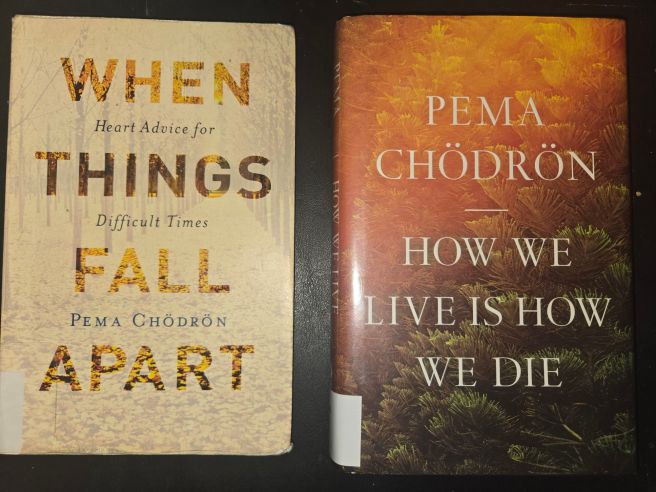
The library book When Things Fall Apart: Heart Advice for Difficult Times (1996), the classic work by American Tibetan Buddhist nun Pema Chödrön, sits unread on my scuffed black card table. Next to it is another of her more recent books, How We Live Is How We Die, also untouched. They’re thin books but on heavy subjects. If you missed it, my last post was 2/2/2025: 7 Lessons from Buddhism, Biking Daily, and the Film “Groundhog Day”. I’m sensing a theme here: finding ways to cope with the sometimes spectacular, sometimes shitty, show that is human life on Earth. With all that’s going on in the US and the world, it always feels a bit trivial to write a blog post about one fat old dude’s bike riding. But it’s not a bad* thing to explore whatever ways that help us navigate difficult times. (Or as George Orwell said in 1984, *doubleplusungood.)
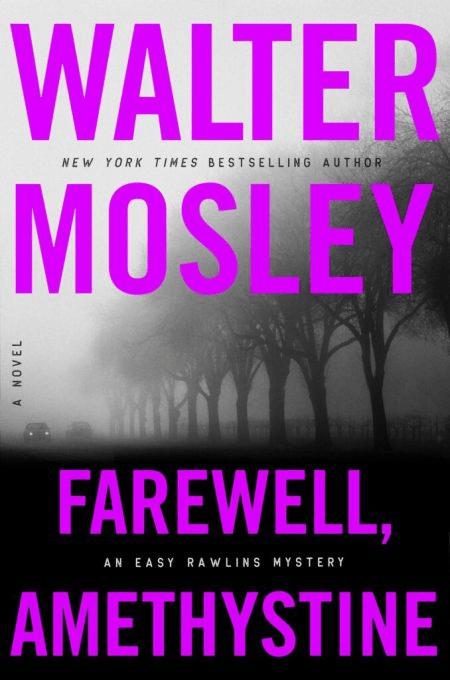
Of course, there are endless things to distract us. I just finished reading Farewell, Amethystine, the latest (#16) in the sublime, sprawling, and satisfying Ezekiel Rawlins Black detective series by Walter Mosley. (I had the great honor of meeting him once at Bookpeople.) I also enjoyed the taut thriller Zero Day with Robert DeNiro, the final season of The Karate Kid spinoff Cobra Kai, Season 3 of the very silly but satisfying Resident Alien, and the Dungeons and Dragons movie, all on Netflix. Plus another nail-biter on Hulu, Paradise with Sterling K. Brown, and the incredible sci-fi datk comedy Severance on Apple TV, the latter being must-see appointment TV at the level of Lost. Also silly YouTube shorts are another; Ryan George’s Pitch Meeting has HILARIOUS movie reviews. It’s hard not to doomscroll about the dystopian, hellscape, shithole country we’re being forced into becoming by a tyranical megalomaniac and his fellow billionaire puppetmasters.
My main escape remains my exercise and fitness activities: my daily walking, yoga, and biking habits all continue apace. Which is an odd turn of phrase, especially since my pace has been slowing down. I don’t know why that is, but weight gain from stress eating and fatigue from my chronic sleep issues certainly play a part. There’s also ample angst from the rampaging Republican regime which is really running–and ruining–the country. (Sorry, not sorry to any followers of the orange emperor; the unsubscribe button is down on the right somewhere, but please wake up and renounce the Dark Side). And there are other trying things I don’t feel like writing about that are challenging A Dude’s ability to abide, like finding a damn job.
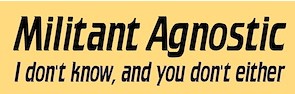
In her book, which I just cracked now that I’m writing about it, Chödrön tells us how to incorporate the teachings of the Buddha in useful and gentle ways. I’m not Buddhist, but I’m not *not* a Buddhist, either. I remain unattached to the title. Maybe I aspire to identify as a lower-case buddhist, given my spotty history with religions, spirituality, and deities (or in my case, the lack thereof as an agnostic atheist–a great post of mine you should read). One of my favorite bumper stickers is this:
But back to the main subject. At its core, meditation or mindfulness works for me as a tool–when I do it. It can help anyone who is not in a super strict cult. By that I mean most religions who take themselves far too seriously. Refer to George Carlin and Ricky Gervais for comic comments on cosmology. By all means, if religion works for you, go for it. Whatever gets you through the day. It’s the organized religious persecution of people who fervently believe in an invisible space ghost that is different from yours (and who will rape, pillage, burn, and kill over) that I’m not a big fan of. (Yes, that ended with a preposition. To quote someone I don’t remember, “Let me correct that. “…that I’m not a big fan of, bitch.) I digress.
Each chapter starts with a handy summary paragraph. Chapter 7: Hopelessness and Death, says this:
“If we’re willing to give up hope that insecurity and pain can be exterminated, then we can have the courage to relax with the groundlessness of our situation. This is the first step on the path.”
Western speakers of English may think of a more practical or legal meaning for groundless, as in having no basis in fact. It’s not far off. Yes, there’s ground, and it’s not flat, but certainty certainly is not a real thing, in the grand cosmic sense not in daily life. In her 2020 blog post “The Ground is Always Shifting” in The Dewdrop, she describes it this way:
“In Buddhism we call the notion of a fixed identity “ego clinging.” It’s how we try to put solid ground under our feet in an ever-shifting world.”
I remember the one time I went skydiving around my 30th birthday. After a very nervous ascent, and a scarier than hell “exiting the aircraft” from two miles above the earth, the descent felt like I was floating, not falling. Then the chute opened and I felt, well, groundless. And nauseous. So I asked the taller instructor if I could step on his feet, because my brain had no handle on not having ground to stand (or pedal) on.
So it goes with death–our own, others’, or our egos–because we don’t want to deal with not knowing. We don’t really know how to deal with the vastness that lies within us if we only quiet four minds enough to explore our inner worlds, and also in space. There’s no reference point. We’re just on the third rock from the sun, spinning around, and spinning our wheels. Mostly hurting ourselves and others by the twin baddies of Buddhism: aversion and craving.
So, I hope to read these books. And try to add in five minutes of meditation after yoga. That’s what the latter is for, anyway. The Insight Meditation Timer I’ve been using for almost a decade has plenty of free, guided sessions. But I resist. As Plato said, “The unexamined life is not worth living.”To that I add, “But the examined life is hard as shit.“ Because sitting still, with no distractions, and just being in our imperfect bodies, minds, communities, countries, and world, goes against our ego attachment to life and living and our wanting to escape discomfort, pain, and death.
What’s the point? Read a book, Buddhist or otherwise. Meditate. Breathe. Ride a bike. Journal or write down some stories from your life. Take a walk. Do yoga. Talk to a therapist. Smile at your neighbor. Whatever works for you to try to start to let go of the clinging to the madness all around us. Guess what? It’s all impermanent!
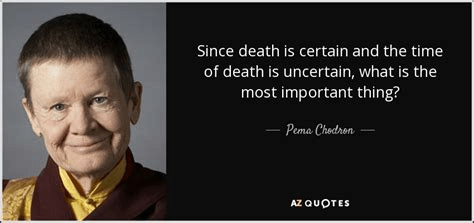
Or maybe there isn’t a point. But I think there is something to sitting in silent meditation. If I can get myself to do more of it, the benefits will accrue. Actor and producer named Martin Gabel in 1945 (with the word stand instead of sit) said this, and it’s also the name of another Buddhist book by Sylvia Boorstein:
Thank you for visiting me on WordPress or at https://ADudeAbikes.com. Feel free to add your Likes and Comments and to Follow the blog here or by email. Contact me at the email on the About page with any questions. Please feel free to Re-blog and Share as long as you give credit and the permalink.